> For the complete documentation index, see [llms.txt](https://docs.sheetmonkey.io/llms.txt). Markdown versions of documentation pages are available by appending `.md` to page URLs; this page is available as [Markdown](https://docs.sheetmonkey.io/policies/what-permissions-are-required-to-use-sheet-monkey.md).
# What permissions are required to use Sheet Monkey
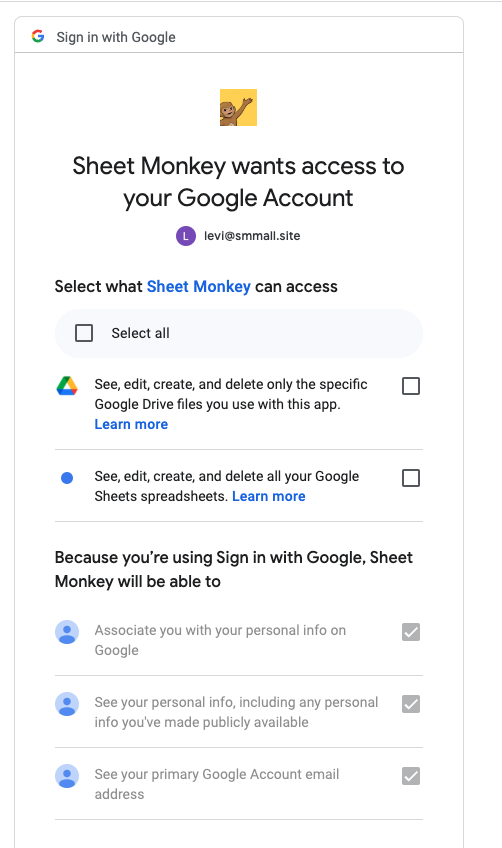
When you sign up to Sheet Monkey, you are asked to accept the following authorizations:
| Scope | How we use it |
| ----------------------------------------------------------------------------------------- | ---------------------------------------------------------------------------------------------------------------------------------------------------------------------------------------------------------------- |
| See, edit, create, and delete only the specific Google Drive files you use with this app. |
This scope is required to perform the following actions:
Creating Sheet Monkey templates in your Google Drive.
Saving data in existing sheets that you select.
|
|
See, edit, create, and delete your spreadsheets in Google Drive
|
This scope is required to perform the following actions:
Saving data into the spreadsheets that you've linked to your Sheet Monkey forms.
|
### Does the Sheet Monkey server list my files?
No.
Sheet Monkey only reads your files in the client browser using the [Google Picker API.](https://developers.google.com/picker/docs) At no point do we browse files in your drive using our backend servers using the Google Drive API.
### Does the Sheet Monkey server read my spreadsheets?
The Sheet Monkey server will read the first row of spreadsheets that you have linked to a form to get the headers for the columns. It does not read any other part of the spreadsheet.
It does not read any spreadsheets that you have not linked to a form.
### Does Sheet Monkey update my files?
The Sheet Monkey server will update spreadsheets that you have linked to a form by adding rows and columns as the form is submitted.
Sheet Monkey will never update a spreadsheet that you have not linked to a form.
### Does Sheet Monkey delete my files?
No.
Sheet Monkey will never delete a file in your drive. Even if you delete the form, it will not delete the sheet you have linked to it.
### What data is stored by Sheet Monkey?
* **User information:** We store Google **user profile information** to link your forms to your Google account. We do not store passwords.
* **Tokens:** We cache a **temporary access token** generated by Google. These tokens automatically expire and are automatically deleted from our cache as soon as they expire. We also securely store a **refresh token** to generate new access tokens as needed.
* **Spreadsheet information:** We only store the **ids of the spreadsheet** that you chose when you link it to a form. We do not permanently store any other information or data that is inside a linked spreadsheet or any data that is added to a spreadsheet using Sheet Monkey. Sheet Monkey may temporarily store submitted data for a period not exceeding six months.